 James Lewis
From AI to unifying the HCP & DTC playbooks — innovation is driving change in the pharma marketing landscape
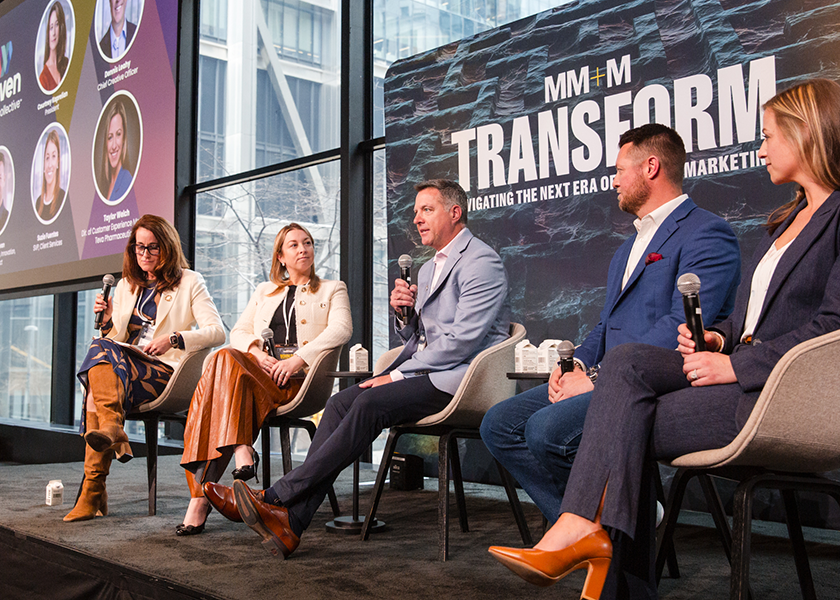
On March 31, the pharma marketing world convened in New York City for MM+M Transform 2026. The agenda spanned AI, DTC strategy, patient access, and the forces reshaping how life sciences companies engage patients, providers, and caregivers to better commercialize their innovations.
Woven Health Collective was proud to be there as a sponsor and panel member. We left with sharp perspectives on where the industry is headed and what it means for how we all work. Here are the five takeaways that stood out most.
1. AI is a coworker, not a shiny object
Bayer’s Brian Cantwell opened the day with a morning keynote that cut through the noise. As VP and Head of AI at Bayer Pharmaceuticals, Cantwell made the case that AI should be treated like a coworker—not a science project. His analogy: nobody sent you to a training course to learn email or a web browser. You picked them up by using them, and AI should follow the same trajectory.
It is a compelling framing, though we would add a practical caveat: while day-to-day AI adoption should feel intuitive, organizations still need intentional training around compliance, data protection, and responsible use guardrails. The tool may be easy to pick up, but the rules of engagement in a regulated industry are not.
Cantwell’s broader message was direct: stop chasing tools and start chasing outcomes. He pointed to industry research suggesting that the vast majority of organizations investing in generative AI are seeing little to no return. The difference-maker is not the technology itself. It is whether a company has rewired how it works around AI—skills, mindsets, and workflows included.
For pharma, the primary business case right now is efficiency. Personalization and improved content quality are important, but harder to quantify. And on the classic 'buy versus build versus rent' question, Cantwell noted that most of Bayer’s AI investment currently falls in the “rent” category: use the tools, extract value, learn—and only build internally when there is a clear case for scale across brands and geographies.
The bottom line: AI adoption is not about buying the right tool. It is about building the right habits—and the right guardrails—across your organization.
2. Agencies: Deliver efficiency or get left behind
One of the more candid moments of the day came when Cantwell turned his attention to the agency landscape. Too many agencies, he argued, are walking into client meetings pitching AI tools with licensing fees attached—chasing the shiny object rather than delivering on the actual promise of AI: better work, faster, at lower cost.
On the pharma side, procurement teams are energized by what AI efficiency can unlock. The conversation has shifted from negotiating rate cards to expecting a fundamentally different way of working.
The agencies that are winning are those reimagining their processes. Cantwell highlighted one partner that compressed a traditional three-to-four-month creative concepting timeline into a two-to-three-day AI-powered workshop—at a fraction of the cost. That is the kind of transformation that makes procurement take notice and ensures value flows through to pharma partners.
The bottom line: if your agency can consistently deliver faster, higher-quality work and stay ahead of what AI can do on its own, you win. If not, there will always be another RFP.
3. Write your plans in pencil
If Bayer opened the day with operational reality, Google’s Dr. Garth Graham closed it with a strategic mandate: be flexible or be irrelevant.
As Director and Global Head of Healthcare and Public Health at Google and YouTube, Graham pointed to YouTube surpassing one trillion views on health care content globally. “Dr. Google” is no longer a punchline—it is a reality that empowers patients and reshapes the care journey.
His advice: simplify your language, because complex scientific jargon does not perform well in AI-powered search. Create bite-sized, question-focused micro-content. Embrace “day in the life” storytelling formats that make brands relatable. And above all, stop locking into rigid six-to-nine-month plans.
This theme echoed across sessions. In the DTC panel, speakers from Novo Nordisk and Google emphasized that in the GLP-1 market alone, every quarter brings a different dynamic. The brands building in flexibility—those that can flex across channels in near real time—are the ones positioned to win.
The bottom line: the speed of change in health care marketing has outpaced the traditional planning cycle. Build for agility, or risk investing in a plan that is already outdated.
4. The caregiver is the audience you’re ignoring
Here is a reality check that surfaced during the DTC Dilemma panel: caregivers are now the second most important influencer in a patient’s treatment decisions. In many cases, patients listen to their caregiver over their doctor.
And yet the industry is largely overlooking them.
Caregivers are taking on more responsibility than ever, navigating complex treatment landscapes on behalf of patients who are often overwhelmed. Patient advocacy groups are stepping in to bridge the communication gap between doctors, caregivers, and patients—and the panel identified this as a significant untapped opportunity. Pharma can invest in education, communications, and genuine caregiver support rather than treating them as an afterthought in the media plan.
The bottom line: for an industry that spends billions reaching patients and HCPs, the caregiver gap is a blind spot hiding in plain sight. The brands that close it first will earn outsized trust and influence.
5. The line between HCP and DTC has blurred
One phrase from the conference that is going to stay with us: “Doctors in blue jeans moments.”
The insight is deceptively simple. When physicians go home, they do not stop being consumers. They are on YouTube, scrolling social, and absorbing content the same way their patients do. The traditional wall between HCP marketing and DTC marketing is crumbling, and marketers need to rethink where one ends and the other begins.
This blurring cuts both ways. Therapeutics have become dramatically more complex—especially in areas like oncology and rare diseases—so HCPs need as much education and support as patients. At the same time, physicians are increasingly concerned about misinformation reaching patients through DTC channels, creating additional burden as they re-educate patients who arrive with inaccurate information.
The opportunity is to build ecosystems that serve both audiences with a connected strategy: educating HCPs on products, offers, and patient support programs while ensuring that what patients and caregivers encounter through AI search and social channels is accurate, accessible, and consistent with what their doctors are telling them.
The bottom line: HCP and DTC are no longer separate playbooks. The brands that connect these strategies into a single, coherent ecosystem will reach the right people at the right moment—regardless of which hat they are wearing.
MM+M Transform 2026 made one thing clear: the pharma marketing playbook is being rewritten in real time. AI is not coming—it is here, and the winners will be organizations that treat it as a way of working rather than a line item. Patients and caregivers are more empowered and more skeptical than ever. And the old walls between audiences, channels, and planning cycles are giving way to something faster, more fluid, and more human.
At Woven, we are energized by these conversations and proud to have been part of them. We are excited to bring our strategic, scientific, and creative capabilities together to build campaigns that engage patients, providers, and caregivers simultaneously—and we are energized to be at the forefront of leveraging AI to drive efficiencies in commercialization. We lean in differently.
If any of these takeaways sparked a thought—or a debate—we’d love to hear from you. Click here to connect with us.